Introduction
It was during one of those quiet Sunday afternoons here in Sydney Australia when I first noticed the subtle crackling in my home theater system. The sound that had once filled my living room with crystal-clear movie dialogue and immersive musical scores had gradually developed a persistent background noise that I couldn’t ignore any longer. As someone who values quality audio but isn’t necessarily a technical expert, I found myself facing a dilemma that many homeowners encounter – how to improve sound quality without completely overhauling an existing setup.
The gentle hum of Sydney’s distant traffic provided the backdrop to my audio troubleshooting journey. I had moved into this apartment three years ago, carefully setting up my entertainment system to create that perfect weekend escape. Now, the very system designed to provide relaxation was becoming a source of frustration. Little did I know that this minor annoyance would lead me down a path of discovery about something as seemingly simple as audio cables.
What began as a quest to eliminate background noise evolved into a much deeper appreciation for the components that make up our everyday audio experiences. The journey taught me that sometimes the most significant improvements come from addressing the most fundamental elements of our systems. This realization would eventually lead me to understand why proper cabling matters more than I ever imagined.
Real-life Context
My Sydney apartment serves as both my living space and entertainment hub. Like many residents in this vibrant city, I’ve created a multi-purpose area where movie nights, music listening sessions, and casual gaming all happen within the same four walls. The space isn’t large – typical of inner-city living – but it’s carefully arranged to maximize both comfort and functionality. The entertainment center sits against one wall, with speakers strategically placed to create the best possible sound distribution throughout the room.
The existing setup had served me well for years. I had a decent amplifier, quality speakers, and all the components that should have delivered excellent audio. Yet there was this persistent issue with the sound quality that I couldn’t quite pinpoint. During intense movie scenes or complex musical passages, I’d notice moments where the audio seemed to lose definition, as if the details were being swallowed by some unseen force. It wasn’t dramatic enough to ruin the experience completely, but it was noticeable enough to be distracting.
Living in a building with multiple units meant I had to consider my neighbors when testing audio solutions. The walls, while not paper-thin, certainly transmitted sound, particularly lower frequencies. This added another layer of consideration to my audio improvement project. I needed something that would enhance clarity without necessarily increasing volume levels. The challenge was finding the right balance between technical improvement and practical living considerations.
My initial assumption was that the problem might lie with the speakers or the amplifier itself. I spent weeks adjusting settings, repositioning components, and experimenting with different audio sources. Nothing seemed to make a substantial difference. The subtle distortion remained, like a guest who had overstayed their welcome. It was during this period of experimentation that I began to consider the possibility that the issue might be more fundamental than I had initially thought.
Observation
The turning point came when I decided to trace the entire audio path from source to speaker. I carefully disconnected each component, inspecting connections and testing individual parts. It was during this process that I noticed something interesting about the cables connecting my amplifier to the subwoofer. The existing cables felt flimsy, and the connectors showed slight signs of corrosion. More importantly, when I temporarily replaced them with a borrowed set from a friend, the audio quality improved noticeably.
This observation led me to research audio cables more thoroughly. I learned about concepts like shielding and conductor quality – things I had never considered important before. The technical specifications began to make sense in practical terms. A 35mm² CCA conductor, for instance, wasn’t just a number on a spec sheet; it represented the pathway through which audio signals travel, and its quality directly affected how much of the original signal reached the speakers intact.
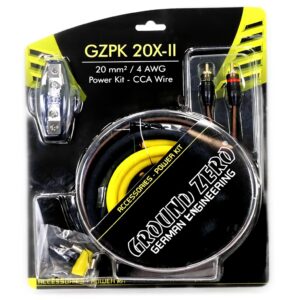
Installing the new cable system revealed several practical aspects I hadn’t anticipated. The 5-meter length proved perfect for my setup, allowing clean routing behind furniture without stretching or creating tension points. The pre-crimped cable ends made connection straightforward, even for someone with limited technical experience. What surprised me most was how the integrated 200A ANL fuse holder added a layer of security I hadn’t realized was missing from my previous setup.
The difference in audio quality became apparent during the first movie I watched after installation. Dialogue that had previously been slightly muffled now came through with remarkable clarity. Background scores gained depth and separation I hadn’t experienced before. The subtle crackling that had plagued my system was completely gone. It was as if I had been listening to music through a slightly foggy window that had suddenly been cleaned.
Reflection
I didn’t realize at the time that this would be so important, but the entire experience changed how I think about the components we often take for granted. In our pursuit of better audio, we frequently focus on the obvious elements – speakers, amplifiers, source quality – while overlooking the humble cables that connect everything together. This oversight, I’ve come to understand, can undermine even the most carefully selected audio components.
The concept of shielding, which I had previously considered technical jargon, now made perfect sense in the context of my Sydney apartment. With numerous wireless devices, electrical appliances, and the general electromagnetic noise of urban living, having proper protection against interference isn’t just a luxury – it’s essential for maintaining audio integrity. The copper-clad aluminum construction, while not pure copper, provided the right balance of conductivity and practicality for home use.
What struck me most was how this single change affected my overall entertainment experience. Movie nights became more immersive not because of louder sound or more dramatic effects, but because of the clarity and purity of the audio. Musical passages I had heard dozens of times revealed subtle details I had never noticed before. The improvement wasn’t dramatic in a sowy way; it was subtle yet profound, like discovering depth in a familiar painting.
This experience also made me reconsider how we approach problem-solving in general. Often, we look for complex solutions when the answer might lie in addressing fundamental components. The cable replacement required minimal technical skill and relatively modest investment, yet it delivered results that far exceeded my expectations. It was a reminder that sometimes the most effective improvements come from perfecting the basics rather than chasing cutting-edge technology.
The safety aspect of the integrated fuse holder, which I initially viewed as a technical feature, took on new meaning after installation. Knowing that my system had protection against power surges and overloads provided peace of mind that extended beyond audio quality. In a city where electrical stability can vary, particularly during summer storms, this additional security felt like a wise investment in both equipment protection and peace of mind.
Conclusion
Looking back on this audio journey from my Sydney home, I’m struck by how much we can learn from addressing what seem like minor issues. The persistent background noise that started this entire process turned out to be a valuable teacher about the importance of quality components throughout an audio system. What began as a simple troubleshooting exercise evolved into a deeper understanding of how interconnected our technology choices really are.
The improvement in my home theater experience has been both measurable and meaningful. Movies feel more immersive, music sounds richer, and even casual television viewing benefits from the enhanced clarity. But beyond the technical improvements, the experience has changed how I listen. I’m more attuned to audio quality now, more appreciative of the engineering that goes into creating seamless entertainment experiences.
This journey has also given me a new perspective on the relationship between our living spaces and the technology we incorporate into them. In a city like Sydney, where space is often limited and multi-functional areas are the norm, choosing components that deliver maximum performance without complexity becomes particularly valuable. The right cable solution proved to be exactly that – a simple upgrade that delivered significant returns without requiring major changes to my setup or lifestyle.
What remains with me most strongly is the realization that quality often resides in the details we overlook. The cables that connect our components, the shielding that protects signals, the safety features that guard our investments – these aren’t secondary considerations but fundamental elements of a satisfying audio experience. As I enjoy another movie night in my Sydney apartment, I’m grateful for the lessons learned from addressing what seemed like a minor audio issue, and for the enhanced enjoyment that came from looking more closely at the components I had previously taken for granted.
 Body Attack Zero Sports Drink Konzentrat zuckerarm vegan
  Body Attack Low Carb Sports Drink Peach-Icetea Konzentrat